Saturday, April 21, 2012

SDS Status Report: April 2012

Hello! I have a couple things here to talk about. First off, as I often do, I must apologize for my lack of attention to the SDS project lately. I was involved with my senior project and another project involving Second Life society, the two of them taking up pretty much all of my time. I've since graduated and restarted work on some projects I had abandoned during my educational pursuits, SDS included. So, I have some bad news, good news, and more bad news involving the fate of the project.

The bad news first. To put it bluntly, I discovered that what I was promising the final version of SDS to do is just not possible right now. Looking back on my proposals, I had adopted two mentalities about all of this. They were "this project is absolutely possible. It's just a matter of making things run fast enough to be convenient to the user" and "this shares concepts with GPS technology, and GPS is fairly fast, therefore this project can be made to be as fast as GPS." I found out empirically that it just can't be made to run fast enough (given the tools immediately available to me), and it's very different from GPS. More on the GPS bit later (in a future article). In conclusion, this project will never reach the state I assumed it would, and so I must insist that SixDegreeSteam be retired.

There's good news too. I'm determined to leave this thing in as much of a working state as can be managed. My intention is to abandon the database approach, create an easy-to-follow graphical output, and have it accomplish the original objective I set out to meet, which was to outline connectivity of one user to the rest of the community. I've already gotten a lot of work in on these points in the past couple days. There's a lot more to go, but at this rate, it'll be done before anyone knows it.

Now the final piece of bad news. Parts of the Steam Community API got updated recently, throwing a generously sized monkey wrench into what used to work in SDS. This slows progress down because I now have to go back and rethink what I already had down. In conjunction, I contacted the Valve employee I understand to be the lead developer on the Steam Community to ask for any information pertinent to the project, or some added public API functionality, or anything to help me out. I was met with a shockingly uninterested response I interpretted as "we've made tools available already. We have no more time to spend helping you datamine," which was understandable albeit surprising given Valve's invested interests in other community members and modders. Things have stacked against me and this project's success from the beginning. I was really hoping to catch a second wind from Valve.

To finish off this status report, I'd like to reiterate just how sorry I am to have taken so long with all of this, only to let everyone waiting patiently on it down. I've appreciated the interest, comments, feedback, and time each person has given to SixDegreeSteam. It's with a heavy heart and a shameful disposition that I must break this news to you. SixDegreeSteam will soon be concluded. After this next client release, it'll all be put away until I can acquire better means to meet all my promises. If you want to keep an ear in it so you can be aware of such a day, I suggest subscribing to this blog (for news on SDS and my other projects) or staying a member of the SDS Steam group. Again, sorry.

Thursday, January 05, 2012

56 Days of Second Life

Coming back from a long hiatus (wow, has it really been a year?), I went back to school earlier this week. My new classes have officially started, and boy are they monsters! The good news is this is the last stretch for me before graduation. The bad news is that these classes are going to eat up every ounce of my spare time.

One of the two classes I'm enrolled in now is an Emerging Technologies course. Along with a couple other assignments, we have to work on a project that demonstrates, well, emerging technologies! I've decided to do an 8-week-long project focusing on the social interactions that take place in Second Life. It was between that or a robotics project, and I don't feel confident enough with physical electronics to have my academic success ride upon it. At any rate, this project should be really interesting! If you'd like to follow it, I'm required to maintain a blog detailing my findings and analysis of what I observe. You can find it over here.

On a related note, expect an update on SDS pretty soon. It'll probably upset a lot of people, but it's high time I speak up about it. See you in a day or two!

Saturday, January 22, 2011

SixDegreeSteam 1.6.6 "Pure Client" Beta Live

Im very proud to announce the release of SixDegreeSteam version 1.6.6 ("Pure Client") available at the SDS site. This is a closed beta that anyone can download and use, but will only work with Steam profiles that are members of the SDS Steam group. This version is NOT meant to be representative of SDS, which is to say this is just a technical demo. It doesnt include all planned features, is expected to run pretty slowly (its dependant on your processor, memory, and internet speed), and will most likely not find relationships larger than 5 profiles long (at least not with the default user limit. Even if you up the limit, itll still take a really long time). So what DOES it do? Heres the list:

  • DOES find your relationship to closely related users (5 or less recommended)
  • DOES print found relationships in a list structure
  • DOES show the potential of the project, and why the dependence on the server is so important (seriously, do you really want to have to use a program this slow?)
  • DOES NOT generate links using groups or private profiles
  • DOES NOT have a graphical user interface (unless you count the command prompt as graphical)
  • DOES NOT print the relationships in a very user-friendly manner (yet...Im working on that)
  • DOES NOT find relationships unless at least one of the given profiles is a member of the SDS Steam group

This is really only meant to show the current standing of the technology and give a sense of why the project is taking so long to complete. Trying to get something that is inherently very slow to work fast enough to be usable is not an easy task. Just remember that this is only the start of a potentially great project. Please be patient.

In the meantime, I hope everyone who tries the beta understands that it isnt, nor is it meant to be, very good or user-friendly. There is a lot to still be done. If you have comments, please let me know. I love hearing from you all!

Thanks so very much for your gratious and humbling interest
- Blake (ROOT)

Wednesday, July 07, 2010

Drunken F00l Got Ripped, Son!

So, one of the biggest names in the Team Fortress 2 world got banned by the Valve Anti-Cheat system recently. Drunken F00l's profile is now marked as VAC banned. Most likely, this was because he received one of the most coveted in-game items at the moment: The Golden Wrench. Only 100 copies of this item were to be given out randomly, and he received one supposedly via an exploit.

The funny thing is he also has one of every hat, which just doesn't happen. The focus now turns to whether he has always had the ability to get any in-game item he wanted. Either way, it's a hillarious consequence toward a classic, yet undeniably influential, douchebag.

F00l has been behind a bunch of different TF2 modifications, both good and spitting-in-the-face-of-Valve bad. TF2 Items, the idling programs created to unfairly gain in-game items, plugins like SourceOP, and multiple new game modes such as Prop Hunt were all his doing. (Edit: It turns out Prop Hunt was not an original concept by F00l. Instead, it was a clone of a SourceMod plugin created by Darkimmortal. Thanks to Darkimmortal and Geit for pointing this out)

We salute you, Valve! Keep doing what you're doing! And we hate you, F001! Just because you're one of the most recognized TF2 modders doesn't mean you can get away with everything!

Saturday, July 03, 2010

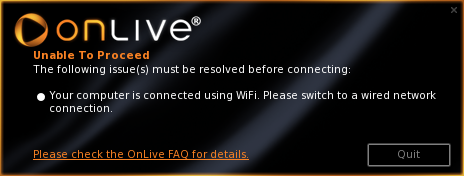
Getting Past OnLive's LAN Requirement

I was lucky enough to be part of the OnLive Founding Members promotion since I pre-ordered way back when the service first came around. If you were too, you might know about the current restriction in place on WiFi connections. Basically, it's a temporary means to limit the ways players can connect to the service in order to rule out connection reliability as a factor during these early stages when troubleshooting is inevitable. As far as I know, this is only meant to help cut down on the amount of calls-for-help from the technologically inapt. Imagine every noob using the service via a wireless connection flooding support forums, inboxes, and phones with problems pertaining to their network connection speed, which is totally not OnLive's problem/fault.


However, I don't think it's all that fair to limit those of us with prominent networking experience and wireless connections. So, I found a way past it. WARNING: Using this method of connecting to the OnLive service will most likely make you ineligible for support from OnLive until either wireless connections are supported or you actually connect through LAN. YOU HAVE BEEN WARNED!

The fix is very simple and can be done on Windows Vista or 7 (perhaps other versions as well, but I haven't been able to verify). Follow these steps:

  1. Right click your network connection icon in the notification area, then choose Open Network and Sharing Center.
    1. OR open your Control Panel, click the Network and Internet category, then Network and Sharing Center.
  2. Click Change adapter settings in the left pane.
  3. Select the wireless network connection you use to connect to the Internet and an unused local area connection (click one, hold CTRL, then click the other).
  4. Right click one of the selected items and choose Bridge Connections. A Network Bridge item should be created.

Enjoy! The only real side effect I noticed about this procedure is that your network connection icon may display the disabled/unconnected icon even if you are fully connected to the network and Internet. If you don't mind that, this work-around is pretty solid. When OnLive adds WiFi support or if you decide you want your LAN connection back, just go back into the adapter settings and delete the network bridge item.

PS: Add me as a friend or spectate me sometime! My gamertag is Blakeo_x.

Monday, March 01, 2010

SDS Status Report: February 10

The past month has been very dull for the SixDegreeSteam project, unfortunately. A lot of personal baggage has bullied progress to the bottom of the stack. However, with a new month comes a renewed working spirit. February wasnt completely without change for SDS, though. The general crawling was halted early in the month. The decision to do so was based on the fact that an accurate backbone has already been developed (the purpose of the general crawling) and that crawling on a relational chain basis, which is much more time- and resource-friendly, will likely replace a huge portion of the general crawling dataset upon client release. The SDS crawler has also reached a new version. SDS Local Server 1.6.1 reduces the residential memory to the SteamUser class, features a slightly modified database querying scheme to [fractionally] speed up present and future data acquisition, and utilizes a new community page wherein friend data is stored in XML format, speeding up crawling and reducing bandwidth consumption.

March is likely to be a very productive month for SixDegreeSteam. With any luck, the client will be ready for public use soon!

Sunday, January 31, 2010

SDS Status Report: January 10

A full month of crawling has passed, leaving the database pretty full and everyone involved with the project ecstatic to see everything coming together. A lot of progress has been made since the last report, so there is a lot to report on here. Strap in!

On January 3, this discussion took place:

January 3, 2010 chat between Blake "ROOT" and Harry "BlackSyte":

Blake: SDS is running a lot slower now that things are filling up, and the partitioning [of the database in an attempt to make things faster] didnt go over too well. My next attempt will be to do manual partitioning, but I dont want to do it right now because I just worked pretty hard to repair the damage the automatic partitioning did...It slowed things down to 1 process per minute.

With the current table loads and everything back to normal, its about 50 profile processes per minute. Its not THAT bad, but it isnt fast enough. Something exciting, though; SDS has reached the edge nodes. The very first Steam user has been crawled, and the very last Steam user (as of this writing) has been crawled. All that is left is everyone in between! But, it stands to prove that my theory might hold weight afterall. It shows that someone, thereby everyone, in the SDS Steam group is connected to both the minimum and maximum edges.

On January 18, SixDegreeSteam Local Server 1.5.87C (the current version) was implemented. It is thus far the most stable release with many improvements over the initial release from December. Family 1.5 brought in better error handling, a logging mechanism, parameter-based execution, a "prioritize child nodes" option for high-priority queue entries, and some programmatic fine-tuning. Release 1.5.87 introduced multi-threading for running multiple local servers (crawlers) consecutively and fixed some profile tracking issues that were previously irreproducible in production.

On January 21, the client algorithm was successfully executed. The interface is still a couple weeks out, but is coming quickly. Work on the interface was stalled after the 21st due to coursework and may continue to be stalled for 4 more weeks.

As of this writing, the database reports these statistics:

- Users crawled: 2,518,356
- Groups crawled: 748,140
- Profiles pending: 5,988,765
- Total discovered users: 7,791,431
- Total discovered groups: 748,141
- Average time between discovery and crawling: 9 days

Bonus: This is a discussion that took place on January 5. It doesnt do much to prove progress of the project, but does offer some interesting food for thought:

January 5, 2010 chat between Blake "ROOT", Dallas, and Harry "BlackSyte":

Blake: Its amazing how quickly the graph edges progressed.
Dallas: But the surface has only been barely scratched.
Blake: Exactly! I mean, we arent even half way through all the users, yet a streamlined backbone has emerged. That raises a concern...Perhaps there are more profiles with a betweenness centrality less than or equal to their degree centrality than I thought. Since a rigid, well-defined backbone has already formed so early in the project, yet there are relatively no user discoveries, it makes me think[...]

There are two possible conditions under which this would happen, guessing that the crawler itself is not at fault, and my confidence of that is fairly high as of 1.5C. First [possibility], there are a shitload of people who form "clicks" [or] small collections of friends who do not join groups or befriend "outsiders"...and by shitload, I mean over 80% of the entire demographic. Thats hard to believe, but not improbable.

The second case, which is even mmore unlikely but is very possible given a generational standpoint, is that there are sections of the entire demographic who are only friends with other members of the same section. So, you have 4 million users in segment A who are friends with other users in that same section, but none of them are friends with users from section B.Its incredibly unlikely, but its a valid portrayal of an existing graph theory called generational demography -- Newer users tend to be friends with other newer users, while older users tend to be friends with other older users, and never shall the two meet.

Heres another interesting observation Ive made. The queue timeframe is currently 9 days...Now, what that means is that there is a 9-day waiting period between discovery and crawling. Its a common occurrence in the crawler that a profile will become invalidated within those 9 days; A wildly common occurrence, in fact. People are deleting their profiles or changing their profile names way too often, somewhere between 1 to 9 days!
Harry: Does that hamper the crawling process?
Blake: In the first release, yes. The crawler would actually crash with a fatal error because it was expecting the profile to be there, but it wasnt. That would happen in the first couple days of launch before I patched it, which is pretty funny because that means the profiles were becoming invalidated within 1-3 days!

Thursday, January 14, 2010

SixDegreeSteam: Synopsis

I was curious as to a means that people like myself could come to an understanding on roughly how this program works... I understand what the goal of it is, but how do you intend to do this?...

- TopRaman

While I have explained a lot of SixDegreeSteam's abstract mechanics in previous articles, I feel they were not programmatically detailed enough to give a good picture of how exactly the program operates. So, Ill try to fill that gap here. There are three components to the project; Ill try to discuss all of them as simply and cleanly as possible.

WARNING: Previous articles have focused on previous versions of the project. Likewise, this article with focus on the current version of the project as of this writing (1.5C). I feel this current version is the most efficient, so it is likely to stick around for a long time. But, this is a disclaimer just in case the project does change again substantially.

The first and (thus far) most time-consuming component is the crawler. Without it, the project would not have a dataset. The crawler has the straight-forward job of collecting links to other profiles from one profile, saving (queueing) those links, then opening them back up sequentially to collect more links. The process continues until all links are collected and thereby all profiles are analyzed. This process of collecting, storing, reading, and repeating is called crawling. The specific crawling logic will not be described here for the sake of brevity, but all the details can be found in an earlier post titled SixDegreeSteam: Challenges. Program-wise, though, the crawler downloads the pages containing the links, extracts the links using a combination of Regular Expressions and XML parsing, and inserts them into a SQL database table called the crawler queue. The crawler also extracts some basic profile information, such as SteamID, profile name, and avatar, in a similar manner and inserts it all into another table called the user dataset (or group dataset). The complete list of datums stored per user is SteamID, last crawl time (to prevent recrawling a user too frequently), profile name, avatar, friends, and group memberships. The complete list of datums stored per group is similar: SteamID, last crawl time, group name, avatar, and members.

Given that the crawler does its job correctly, we are left with a database filled (and I mean FILLED) with information about the users and groups of the Steam Community. Oddly enough, the information is pretty inconsequential without a way to harness the datasets. So, our second component, aptly named Pathfinder, is arguably as important as the crawler. Pathfinder has the soul purpose of using the information available through the database to calculate a lowest-cost path between two given nodes. To do this, Ive opted for an object-oriented rendition of the breadth-first search graph theory algorithm. Once again, for the sake of brevity, I wont go into detail about the algorithm. If you are curious about it, follow the link or run a Google search. There are tons of articles that have covered it far better than I can. After the algorithm is applied, a list of users and groups used to reach profile B from profile A the quickest is displayed with links to each profile and avatars for recognition purposes.

The third and newest addition to the component set is a sort of network browser. Using a graphical, navigable web of the dataset, users will be able to quickly traverse the entire Steam Community social network, allowing them to get a better idea of just where they fit into it all. This component is simply an auxiliary to the project and is not a real focus. As such, it will be the last to be implemented and will only even enter the development picture after the crawler and Pathfinder are thoroughly completed.

As was said about Pathfinder, the information gathered by the crawler is pretty useless to the end user until a method of putting it to work is created. This explains why the crawler has been operational for nearly a month now, yet the site is still empty.

Sunday, December 27, 2009

SDS Finished (For Real This Time!)

The centerpiece of the project, the SixDegreeSteam crawler/server, has been thoroughly completed. Since the promised launch date of December 25, the crawler was experiencing memory issues that would cause it to die roughly 5 minutes after startup. Im very pleased to announce that version 1.5.77C of the crawler (yes, it seriously took that many revisions to get everything up to working conditions) is now in effect, and running smoothly!

Now I can switch over to working on the client software. More about that will be released later. Here are some statistics about the limited runtime the crawler got between its crashes.

- Uptime: 2 hours
- Users crawled: 1,961
- Groups crawled: 10,337
- Users/Groups pending: 408,376

A special thanks to everyone who has sent me emails, joined the Steam group, and otherwise completely overwhelmed me with their gracious comments! Its truly inspiring to see so many people in support of what I invisioned to be a small personal project. As always, feel free to email me with questions, comments, concerns, or funny lolcats. blake.oxx@gmail.com (remove the dot)

Wednesday, December 16, 2009

SixDegreeSteam Finished

After about 3 months of development, SixDegreeSteam has reached the final steps in the launch process. The database has been set up, the crawler has been completed, and the folks at Valve have been sent "please let me borrow your bandwidth" cookies. Everything is pumped and primed. However, the project has not yet been released on the community. Why? Because Valve has not yet agreed. As soon as the green flag is given, the experiment will begin full-force.

As a side note, a previous article I posted about how SDS would acquire information is wrong. Actually working on the program and digging through the Steam Community site has enlightened me a little more about the crawling process. The article will be corrected as soon as I have time.